After the revolutionary, non-surgical OverStitch® endoscopic sleeve gastroplasty, obese patients can lose up to 40 kg, even within the first six months!

Hillary Liles, on the left – after the non-surgical OverStitch® gastric reduction procedure.
The 38-year-old North Carolina mother realized she needs to take actions, when – upon arriving at Disneyland – she found out that she couldn’t fit into the roller coaster’s seat next to her child. At that time, as shown in the right-side picture, she already weighed 120 kilograms. Thanks to the OverStitch® endoscopic sleeve gastroplasty, she lost 40 kilograms in the first 6 months.
Hillary chose the OverStitch® endoscopic gastric reduction because the procedure, as an intermediate solution between diet and weight loss surgeries, does not burden the body like surgery, but is significant enough to yield truly effective results, she stated. She definitely didn’t want a weight loss surgery as it would have come with serious risks, and she wanted to achieve lasting results without those risks. She succeeded and lost 40 kilograms in just 6 months. She also found it very convincing that she could go home immediately after the procedure, without the need for a long recovery period, and she didn’t experience significant pain. The day after the procedure, she was already driving her child to school, and on the third day, she could return to work. Her son is happy to have his mother back, and her whole family is proud of her achievements, which she accomplished without any risks. Since obesity poses serious health risks, Hillary has essentially extended her life.
„Now I can garden again without feeling like I’ve been hit by a truck,” she adds. “I sleep better, I love being able to fit into smaller clothes. But I still find myself avoiding looking in the mirror, as if I still can’t believe this is happening to me,” she stated.” -nyilatkozta.
This revolutionary procedure is recommended worldwide to both those with significant excess weight and those with smaller weight excess (starting from a BMI of 27), which can help them lose up to 40-50 kilograms. By doing so, it reduces the risk of severe complications of obesity, such as fatty liver, diabetes, high blood pressure, heart attacks, and strokes. One of the tremendous advantages of this procedure is that there is no surgical risk involved.
Briefly about the OverStitch® endoscopic sleeve gastroplasty:
- The procedure, known as endoscopic gastric reduction, is performed through the mouth, where the inner wall of the stomach is cinched with special stitches, reducing the size of the stomach to approximately three-quarters of its original size.
- After the intervention, the patient’s body signals that the stomach is full much sooner than before, allowing them to eat much smaller quantities.
- Patients are informed that if they overeat unnecessarily, the internal stitches may fall apart, and the stomach may return to its original size, this information also serves as a restraining force. These internal stitches typically remain unchanged for years, however, in reality, they are unnecessary after one year, as the body learns to adapt to smaller quantities mentally, typically within the first 6-8 months. It’s a real lifestyle change. If these internal sutures fall out, they leave the body without causing any problems.
- There are still no miracle cures or magic methods, but this procedure is a significant innovation and means a supportive aid for weight loss. After the OverStitch® endoscopic sleeve gastroplasty, maintaining a new diet and achieve weight loss goals is much easier, as the stomach volume is reduced by up to 60-70%. However, diet and exercise are still necessary for any method.
Whether in overcoming minor overweight (starting from a BMI of 27) or as a pioneering intervention for severely overweight patients, the OverStitch® endoscopic gastric reduction has been recommended in several countries since 2010. Depending on the initial weight, a weight loss of 10-50 kg can be expected in approximately 8-10 months.
In England or Germany, local insurance companies already finance the procedure, as patients can lose up to 40 kilograms in just six months. This reduces the risk of complications such as fatty liver, diabetes, high blood pressure, heart attack, and strokes, all while:
- no surgical risk is involved,
- no intensive background is required,
- there are no significant complications; it’s practically the same as being under anesthesia for a stomach endoscopy,
- there’s no long recovery; the patient can return to work within a few days,
- no hospitalization is needed; the patient can go home on the same day, after a few hours.
The development of this procedure began at the Mayo Clinic in the USA and has been successfully used in Western Europe for nearly a decade.
We are proud that this non-surgical method is now available in Hungary exclusively through our company, at our Centrums accredited for OverStitch® endoscopic sleeve gastroplasty.
During the procedure, the walls of the stomach are contract from the inside, reducing the size of the stomach to approximately three-quarters of its original size. The patient does not feel anything during the procedure, as it is performed under anesthesia. The procedure feels to the patient like a simple stomach endoscopy under anesthesia, without the need for a surgical environment or intensive background.
Later, when the patient eats, their body signals much more quickly than usual that their stomach is full. However, it should be noted that if they overeat out of habit, the stitches may fall apart, and the stomach will return to its original size, which is also its advantage that it is reversible. Overeating, of course, leads to discomfort, which is also a deterrent.
Since the success of the procedure also depends on the patient’s willpower, doctors worldwide claim that it is more successful than other so-called invasive surgical methods, and its enormous advantage is that there are no permanent changes and no surgical risks.
Patients who undergo the non-surgical OverStitch® endoscopic sleeve gastroplasty, typically lose an average of 50% of their body weight, and according to research, after two years, eight out of ten patients manage to maintain their weight.

Right to left: Prof. Dr. Rehan Haidry – UK; Andrea Ollári, Director in Hungary; Dr. Áron Vincze, University Professor
Head Physician of the Hungarian OverStitch Center
at the Hungarian presentation of OverStitch
In Hungary, Dr. Rehan Haidry, professor at University College London Hospital, shared the experiences he gained in the United Kingdom:
- In the past, we used to offer the so-called truncated bariatric surgeries for obese patients, where the stomach is stitched and cut to create a small tube. This procedure is irreversible and carries numerous surgical risks which can be life-threatening. After bariatric surgeries, in about 10% of the cases, the stomach stops producing essential digestive substances which would be necessary for the absorption of B12 vitamin. This leads to anemia, the red blood cells’ shortage in the body, which cause extreme fatigue, shortness of breath and many other problems.
- The convincing results of the OverStitch® endoscopic sleeve gastroplasty have fortunately convinced healthcare leaders in England to adopt this method nationwide instead of the high-risk truncation surgeries and this simpler method has replaced them. The downside is the extremely high cost of the necessary equipment, as they are manufactured by a single company worldwide. This extensive know-how was developed over several decades and is of course legally protected.Dr. Rehan Haidry explained, “We have reached a turning point in the treatment of obese patients. The risk of OverStitch® endoscopic gastric restriction is very low, similar to a simple gastroscopy, and patients can go home on the same day, just a few hours later.””Among surgeries, the only reversible bariatric procedure is gastric band, in which a special band is placed around the stomach, to limit the food amount that can be consumed.”However, Professor Haidry added, “Gastric band surgery has gradually been reserved exclusively as a life-saving procedure over the past five years. Although it can help patients lose 50-60% of their excess weight in two years, more than nine out of ten patients later regain the weight. The installation of the band also requires surgery with an abdominal incision, although, among bariatric surgeries, we consider this one to be the most humane.”During the OverStitch® endoscopic sleeve gastroplasty procedure, the stomach is not cut or removed, so there is no truncation, and there are no surgical risks. Instead, instruments inserted through the mouth are used to cinch a portion of the gastric wall, making it 60-70% smaller. This does not burden the patient’s body, and they can go home the same day without any significant discomfort.
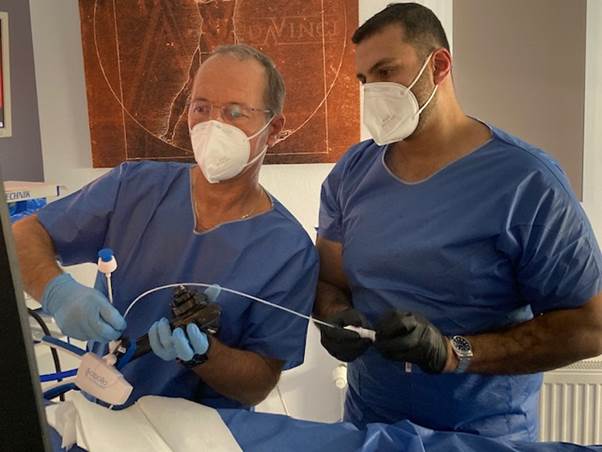
During OverStitch® endoscopic sleeve gastroplasty: Dr. Rehan Haidry (right) and Dr. Áron Vincze, official OverStitch® instructor in Hungary (left)
“If the patient repeatedly overeats for an extended period, the internal stitches may fall apart and the stomach will return to its normal size,” explains Professor Haidry. “But we see remarkable weight loss results because part of the treatment is educating them about this, which helps them control their overeating desires. If they follow what we recommend, they can achieve the desired weight loss and maintain it even in the long term, as the stomach becomes 60-70% smaller, all without surgical risk and without a lengthy recovery. In fact, OverStitch® endoscopic sleeve gastroplasty would be beneficial all of us to more easily learn to eat smaller food portions.”
During the approximately one-hour-long procedure performed under general anesthesia, the accredited doctor inserts a small camera attached to a long, flexible tube, called an endoscope, through the patient’s mouth and into their stomach.
The OverStitch® device is attached to the endoscope, which helps for the leading physician to internally mapping the gastric wall, grasping its sections and cinching them together with the so-called Stitch sutures, like a tobacco bag or a drawstring pouch. The sutures are made from materials that resist gastric acid.
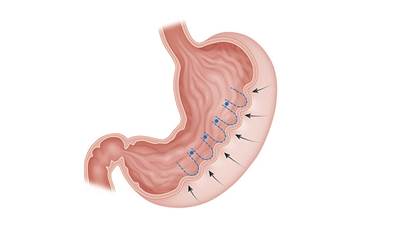
“Approximately four to six sutures are placed from the bottom to the top of the stomach,” explains Dr. Haidry. “This changes the temporary shape of the stomach from oval to banana-like. Most people can go home the same day and return to work within a few days, depending on the type of work they do.

“With bariatric surgeries, patients had to stay in the hospital for one week, and the recovery time could last up to a month,” emphasizes the Professor.
The OverStitch® process is faster, which means that there is no long waiting list in the country, which is extremely important. Obesity is a problem that needs to be addressed immediately, as it can lead to serious illnesses. Therefore, it is crucial that the OverStitch® endoscopic sleeve gastroplasty is available quickly.
Safer method, with significantly lower risks compared to a surgical procedure, while providing the same weight loss results.
The non-surgical alternative, the OverStitch® endoscopic sleeve gastroplasty is exclusively available through us.
CONTACT US BY CLICKING HERE!
Get to know the facts! If you have any questions about the effectiveness of non-surgical weight loss, our experts are happy to help.